Introduction: Operational Functionality is Not the Endpoint
When a sensor successfully transmits data and a model becomes operational, the task may appear complete. However, if instructors inquire why a specific alternative was selected, whether the data is statistically reliable, or how the system mitigates hardware and communication network failures, a merely "functional" product proves insufficient to demonstrate that learners have mastered the solution.
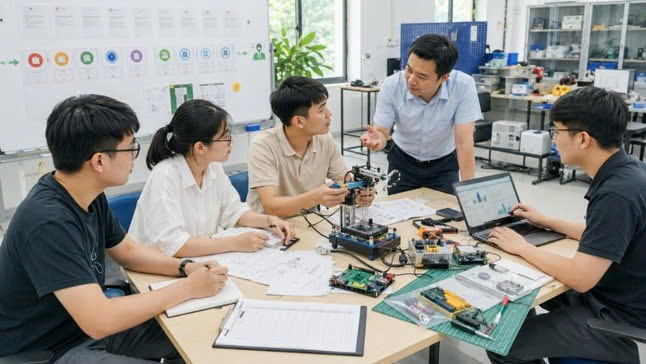
This gap reflects the fundamental distinction between predefined academic exercises and professional engineering tasks. In the professional realm, practitioners must identify requirements, analyze constraints, evaluate alternatives, validate outcomes, and assume accountability for their technical decisions.
Scope of the article: This paper provides a conceptual overview and methodological analysis of the approach; it does not present empirical research data or the outcomes of a specific, implemented project.
1. Defining Project-Based Learning (PjBL)
Project-Based Learning (abbreviated as PjBL in this paper to distinguish it from Problem-Based Learning) is an instructional framework in which students mobilize knowledge and skills to resolve a complex problem or execute a comprehensive task. The core problem must be sufficiently defined for implementation yet remain open-ended, compelling learners to analyze requirements, retrieve information, propose methodologies, execute, test, and refine their solutions [1], [2].
Not all major assignments or group activities qualify as PjBL. A genuine project must be strictly aligned with Course Learning Outcomes (CLOs), grant students appropriate autonomy, incorporate guidance and formative feedback, and evaluate the product, the process, and individual contributions concurrently. The essence lies not in the superficial aesthetics of the final product, but in the students' comprehension of the problem, their justification for the chosen solution, the verification of results, and their accountability throughout the execution process [2].
From Knowledge Acquisition to Professional Competence
Engineering tasks inherently demand the integration of hardware, software, data structures, communication infrastructures, user interfaces, and operational constraints. Students may execute isolated operations proficiently yet experience friction when integrating them into a multifaceted task.
Furthermore, engineering decisions are highly context-dependent. A theoretically sound alternative may prove non-viable if its cost exceeds resources, if the hardware fails to meet specifications, if time is constrained, or if the system poses maintenance challenges. Consequently, an optimal solution is not necessarily the most complex one, but rather one that balances performance, accuracy, safety, cost efficiency, and deployability.
PjBL does not replace theoretical instruction or other pedagogical modalities. Theory remains the foundational cornerstone; the project serves as an authentic environment where learners mobilize, challenge, and calibrate that foundation within a near-professional context [1].
The Mechanism of Knowledge-to-Competence Transformation
The transformation from "knowing" to "doing" occurs when students actively define problems, select appropriate knowledge and tools, propose methodologies, execute actions, validate outcomes, receive feedback, and perform iterations.
A specific module may function seamlessly in isolation but fail upon system integration; empirical data may diverge from theoretical assumptions; and hardware modifications may destabilize software performance, safety, or security protocols. These exigencies compel learners to diagnose root causes, re-evaluate assumptions, and develop engineering judgment.
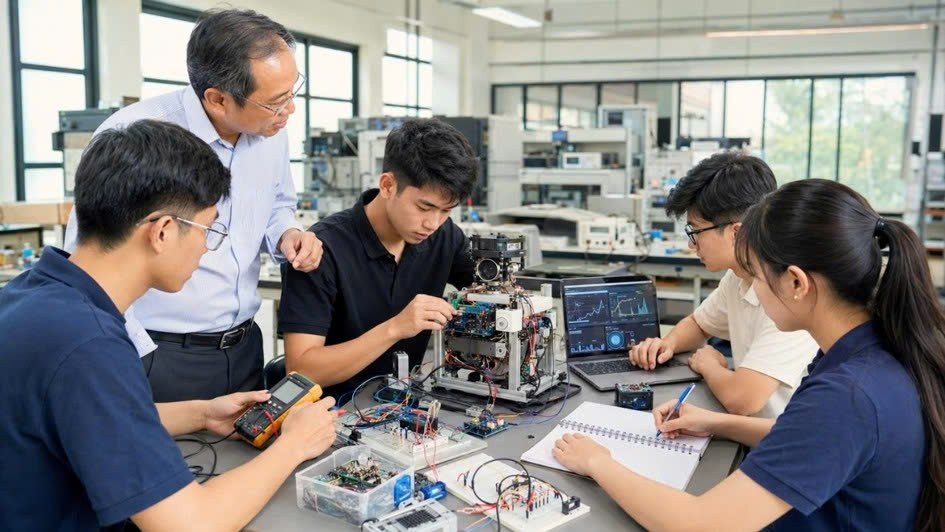
However, competence does not develop autonomously merely by assigning arduous tasks to students. Overly broad projects, deficient guidance, or ambiguous rubrics can disorient learners, leading to inequitable task distribution or a superficial focus on product completion. The scope and complexity of the project must be meticulously calibrated to the students' proficiency level, course duration, and available resources.
Illustrative Framework of an Engineering Project
This methodology can be illustrated through the development of an indoor environmental monitoring system designed to collect temperature, humidity, $CO_2$ concentrations, or particulate matter ($PM$), transmit data, display metrics, and trigger alerts upon threshold breaches. Note: This serves strictly as an illustrative scenario, not a report on a project executed at the institution.
- Commencing with Requirements, Not Technology: Prior to selecting sensors, microcontrollers, or software platforms, the team must clarify the specific parameters to be monitored, the target end-users, the objectives of observation or alerting, operational conditions, and resource constraints. Ambiguity at this stage often results in feature-rich systems that lack functional utility.
- Translating Needs into Verifiable Specifications: The team defines measurement metrics, update cycles, visualization modalities, alert thresholds, and exception-handling protocols for connectivity loss or anomalous data. Qualitative descriptors such as "fast," "stable," or "accurate" must be quantified into measurable thresholds and tolerance levels. Measurement data must specify calibration or cross-checking methodologies, expected margins of error, and testing boundaries.
- Design, Prototyping, and System Integration: Grounded in the defined specifications, the team constructs the system architecture and evaluates design alternatives against performance, cost, stability, maintainability, safety, and security. The optimal technology is not necessarily the most novel. Developing a prototype focused on core functionalities prior to incremental integration enables the early detection of data anomalies, connectivity issues, and modular incompatibilities.
- Testing, Feedback, and Iterative Refinement: The final output must be rigorously cross-referenced with the initial requirements: Is the data stream stable? How does the system respond to network disconnection? Are anomalous values handled correctly? Do alerts trigger at the exact thresholds and timestamps? The empirical outcomes of testing may necessitate recalibrations of sensors, algorithms, transmission protocols, or storage architectures.
Upon completion, students must defend their selection rationale, testing methodologies, system limitations, and future optimization paths. An incomplete product retains pedagogical value only if the team accurately diagnoses the root causes, provides verifiable evidence, and proposes well-founded corrective measures; however, this does not imply that technical quality can be compromised.
2. Pre-requisites for Competence Development via PjBL
The architecture of PjBL requires strict constructive alignment among learning outcomes, instructional tasks, and assessment methods; instructional scaffolding and evidence tracking systems are organized to sustain this alignment [3]. At the programmatic level, Circular No. 17/2021/TT-BGDĐT dictates that the design, implementation, and evaluation of higher education curricula must be strictly outcome-based [4].
Designing Appropriate Tasks
Instructors must specify the exact theoretical knowledge students need to apply, the cognitive and technical activities they must execute, and the specific artifacts they must generate to demonstrate achievement of the learning outcomes. Tasks should mirror authentic professional practices while remaining proportional to the students' academic level, timeline, and institutional resources.
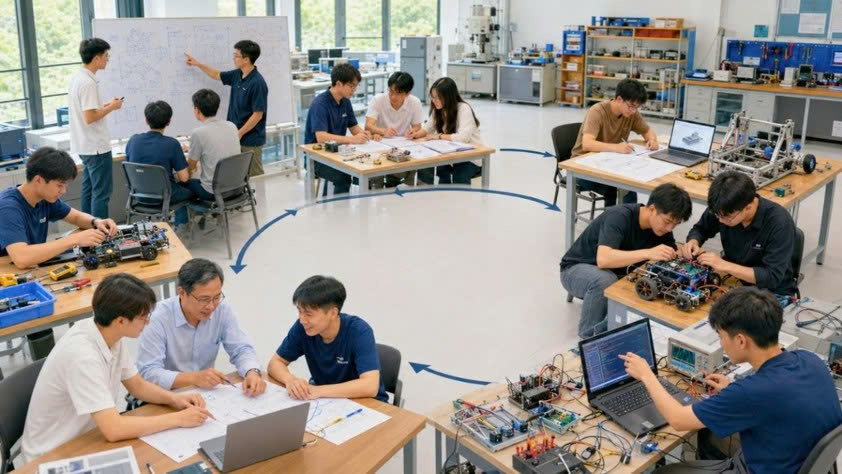
Phased Scaffolding Without Over-Intervention
The inclusion of predefined milestones and formative feedback loops enables students to review their requirement analyses, design rationales, and testing methodologies. Providing overly prescriptive instructions risks reducing the project to a cookie-cutter laboratory exercise; conversely, leaving learners entirely without support can induce cognitive overload and disorientation.
Holistic Assessment of Product, Process, and Individual Contributions
The corpus of evidence should encompass requirement analyses, technical design documentation, engineering journals, version control histories, test logs, the physical or digital prototype, and individual defense reports. Assessment rubrics must explicitly state professional criteria, validation rigor, collaboration quality, and individual accountability, thereby mitigating the risk of equal grading when individual contributions vary significantly.
Validated and Transparent Utilization of Generative AI
Students may utilize Generative AI (GenAI) for benchmarking, brainstorming alternative designs, or troubleshooting source code. However, they must rigorously validate the AI-generated outputs, declare the scope of tool utilization in alignment with course policies, demonstrate a thorough comprehension of the content, and assume full accountability for the final submission. Users must refrain from inputting personal, institutional, or proprietary data into AI tools without explicit authorization. Any component of the project that cannot be explained or lacks clear attribution cannot be accepted as reliable evidence of individual competence [5].
Conclusion: Transitioning from "Knowing" to "Doing"
In engineering education, theoretical knowledge constitutes the indispensable bedrock; however, professional competence is forged only when learners demonstrate the capacity to analyze problems, synthesize solutions, validate outcomes, and iterate under constraints. When properly designed, balanced with appropriate instructional scaffolding, and evaluated through robust evidence, PjBL serves as an effective bridge connecting the academic curriculum to the realities of professional practice.
References
Tài liệu tham khảo
[1] Nguyễn Văn Cường và Bernd Meier, Lý luận dạy học hiện đại: Cơ sở đổi mới mục tiêu, nội dung và phương pháp dạy học. Hà Nội: Nhà xuất bản Đại học Sư phạm, 2014.
[2] J. W. Thomas, A Review of Research on Project-Based Learning. San Rafael, CA, USA: The Autodesk Foundation, Mar. 2000.
[3] J. Biggs and C. Tang, Teaching for Quality Learning at University: What the Student Does, 4th ed. Maidenhead, UK: Open University Press, 2011.
[4] Bộ Giáo dục và Đào tạo, Thông tư số 17/2021/TT-BGDĐT ngày 22 tháng 6 năm 2021 quy định về chuẩn chương trình đào tạo; xây dựng, thẩm định và ban hành chương trình đào tạo các trình độ của giáo dục đại học, 2021.
[5] UNESCO, Guidance for Generative AI in Education and Research. Paris, France: UNESCO, 2023. [Online]. Available: https://doi.org/10.54675/EWZM9535