Abstract
Artificial Intelligence (AI) is fundamentally transforming the global higher education ecosystem. For technology students, AI serves both as a gateway to countless opportunities for learning, creativity, and career development, and as a rigorous test of skills, ethics, and critical thinking. This paper analyzes these two dimensions in parallel, helping learners better recognize their roles, responsibilities, and directions in the age of artificial intelligence.
Keywords: Artificial intelligence, higher education, technology students, opportunities, challenges, digital ethics.
1. Introduction
In the context of globalization and digital transformation, artificial intelligence (AI) is no longer a future trend but has already become an integral part of human learning and professional life. AI is widely applied in healthcare, finance, transportation, cybersecurity, and especially education.
For technology students, AI is not only a learning tool but also a new environment for intellectual development, potential exploration, and value creation. However, along with these opportunities come various challenges that require learners to change their mindsets, approaches, and professional ethics.
2. AI – A new knowledge ecosystem for the generation of technology students
AI has been creating an intelligent learning ecosystem in which knowledge is digitized, connected, and expanded without limits.
With the support of platforms such as Google AI, TensorFlow, ChatGPT, Kaggle, Copilot, etc., students can:
– Access global data repositories and engage in self-paced learning.
– Simulate complex technological processes in virtual environments.
– Experiment, innovate, and evaluate ideas quickly.
The combination of humans and machines is opening a new learning model—learning with AI—where students do not merely acquire knowledge but are also supported in analyzing, suggesting, and verifying information more effectively than ever before.

Figure 1: The new knowledge ecosystem
3. Opportunities – When AI becomes the “second teacher”
AI brings unprecedented opportunities for technology students in three main aspects:
First – Career development opportunities:
The demand for human resources in fields such as Machine Learning, Data Science, Cybersecurity, AI Application Development, and Automation Engineering is rapidly increasing. Those who possess solid knowledge and skills in AI will have a significant competitive advantage in the job market.
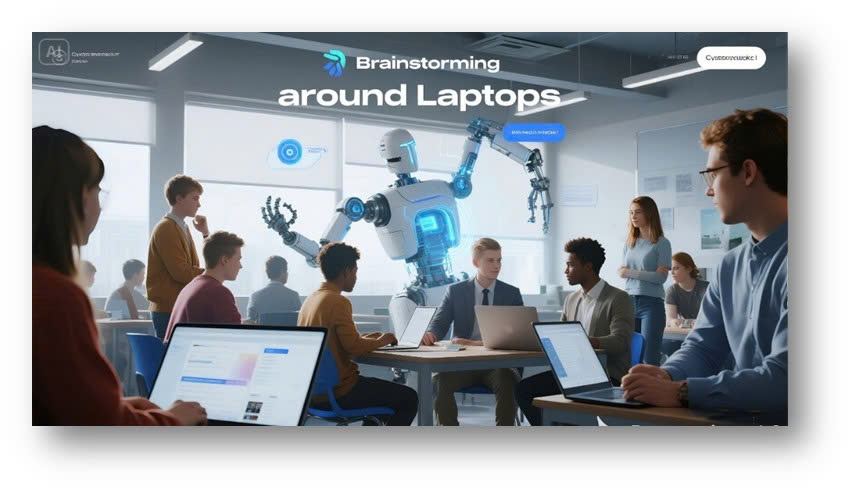
Figure 2: Career opportunities
Second – Opportunities for creativity and entrepreneurship:
AI allows students to experiment with ideas and develop real-world products while still in school. From facial recognition applications and smart homes to data analysis systems, any idea can become a reality thanks to the power of AI.
Third – Opportunities for integration and lifelong learning:
AI has blurred geographical boundaries, enabling Vietnamese students to participate in international projects, take online courses from top universities, and access up-to-date knowledge in real time.
"AI does not replace humans; it only replaces those who refuse to learn how to collaborate with it." — Andrew Ng, Stanford University
4. Challenges – When AI becomes a test of human intelligence
Alongside opportunities, AI also presents technology students with profound challenges, both in terms of skills and ethics.

Figure 3: Challenges and Ethics
Challenges in Academic Ethics:
AI can generate text, images, or source code in just a few seconds. Without awareness, students may fall into the “gray area” between creativity and plagiarism, blurring the boundaries of academic integrity.
Challenges in Foundational Skills:
Many students stop at merely “using AI” without understanding how it works, learns, and processes data. This leads to superficial applications and a lack of professional depth.
Challenges in Critical Thinking:
AI can provide rapid responses but is not always correct. If learners lack the ability to critically evaluate and verify information, they risk becoming “dependent on machines” rather than “mastering them.”
Challenges in Career Development:
As technical jobs become automated, students are compelled to develop “irreplaceable” skills such as creative thinking, communication, emotional intelligence, and professional ethics.
As emphasized by OECD (2022): “AI education is not only about teaching how to operate the systems, but also about teaching humans how to live and work alongside them.”
5. Orientation – Mastering AI with Intelligence, Not Dependence
5.1. Roles and Actions of Students
Technology students are at the forefront of encountering and applying AI in learning. To seize opportunities and overcome challenges, students need to proactively develop three core competencies:
- Technical Competence: Understand how AI operates, master the foundations of mathematics, programming, and data, and know how to build and evaluate machine learning models.
- Critical Thinking and Creativity: Go beyond “asking to know” to “asking to understand and improve.” Be able to frame problems, analyze data, and transform AI results into practical solutions.
- Ethical and Humanistic Competence: Uphold integrity, respect intellectual property, and apply AI for humanitarian purposes without causing social harm.
Additionally, students should engage in lifelong learning, take online AI courses (such as Google AI, IBM SkillsBuild, Coursera), and actively participate in academic clubs, hackathons, and technology seminars to develop practical skills and collaborative thinking.
5.2. Responsibilities and Orientation of Educational Institutions
Universities play a central role in shaping students’ technological competence, digital thinking, and professional ethics. To achieve this, three coordinated measures are essential:
- Integrating AI into the Curriculum: Develop courses such as Foundations of Artificial Intelligence, AI Applications in Engineering and Life, or Ethics in the Digital Era to ensure early exposure and hands-on practice for students.
- Developing a Creative Learning Environment: Invest in AI, IoT, and Data Science labs, encourage students to conduct applied research, and collaborate with industry to solve real-world problems.
- Training Faculty and Promoting International Collaboration: Provide opportunities for faculty to participate in research programs, academic exchanges, and connect with international AI organizations, thereby enhancing the quality of education and global integration.
6. Conclusion
AI is transforming the role of technology students—from passive learners to co-creators alongside artificial intelligence.
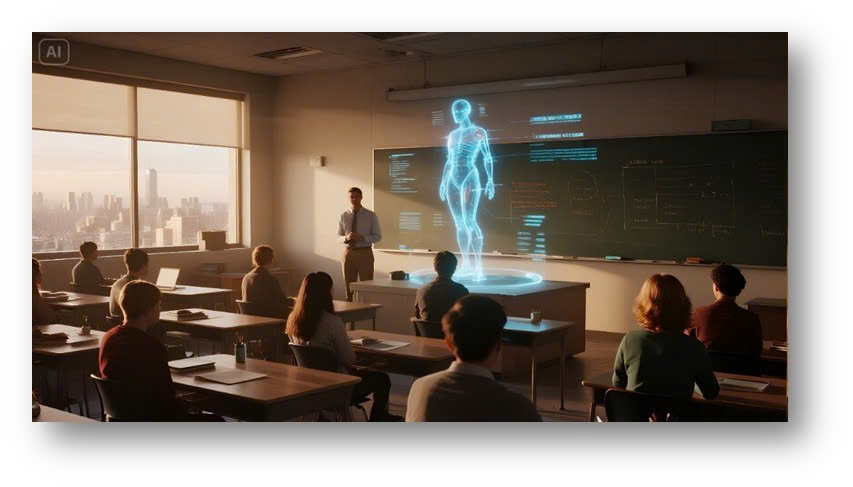
Figure 4: Humans Leading Artificial Intelligence
This is a time when opportunities and challenges go hand in hand: opportunities come to those who learn quickly, understand deeply, and act rightly; while challenges eliminate those who are dependent and fail to take ownership of knowledge.
"AI is truly intelligent only when guided by humans with wisdom and ethics."
The future of higher education does not lie in how many AI tools are used, but in the people themselves—engineers, programmers, and researchers—who nurture creative thinking and humanistic values in the technological era.
Author: MSc. Dinh Van Phung
Faculty of Engineering and Technology – Binh Minh Saigon College
Email: phungdv@aurora.edu.vn
References
1.Andrew Ng. (2023). The State of Artificial Intelligence in Higher Education. Stanford AI Lab.
2.UNESCO. (2022). AI and Education: Guidance for Policy-makers. Paris: UNESCO Publishing.
3.World Economic Forum. (2024). Future of Jobs Report 2024 – AI and Skills Transformation.
4.Harvard Business Review. (2023). Teaching with AI: Opportunities and Ethical Challenges in Higher Education.
5.PwC Global. (2023). How AI is Changing Work and Learning. PwC Technology Insights.
6.McKinsey & Company. (2024). Reimagining Education with Artificial Intelligence.
7.OECD. (2022). AI in Education: Implications for Teaching, Learning and Policy. OECD Publishing.
8.Ministry of Education and Training of Vietnam. (2023). Digital Transformation Orientation in Vietnamese Higher Education. Hanoi.
9.IBM Research. (2024). AI Ethics and Human-Centered Design in Academia.
10.Google for Education. (2024). AI Literacy for Students: Learning with Responsible Technology.