Abstract
In the context of rapid digital transformation and the Fourth Industrial Revolution, Drones (Unmanned Aerial Vehicles - UAVs) have emerged as one of the most prominent technologies attracting global interest. No longer confined to historical military applications, contemporary drones are widely utilized in smart agriculture, environmental monitoring, topographical surveying, search and rescue operations, logistics, and various other civil sectors.
Behind their stable flight capability, autonomous navigation, and real-time data transmission lies an integration of advanced core technologies within the Electronics and Telecommunications Engineering domain. These include embedded systems, smart sensors, wireless communications, digital signal processing, and artificial intelligence (AI). Consequently, this has become a prominent area of academic research and practical application accessible to students majoring in Electronics and Telecommunications Engineering during their studies and research.
1. Introduction
A Drone or UAV (Unmanned Aerial Vehicle) is an aircraft capable of operating without an onboard human pilot. Utilizing remote control systems or autonomous algorithms, drones can execute takeoff, navigation, positioning, and various specialized missions.
Technological breakthroughs in microprocessors, Micro-Electro-Mechanical Systems (MEMS) sensors, Global Positioning System (GPS) technology, and wireless communication networks have rendered drones increasingly intelligent, compact, and efficient. Evolving from rudimentary research flight platforms, drones have transformed into critical tools across numerous modern industries.
Within the scope of Electronics and Telecommunications Engineering, a drone is categorized as a classic integrated system, requiring the synthesis of interdisciplinary knowledge ranging from electronic circuit design and automated control to communication and data processing.
2. Structural Componentry and Operational Principles of Drones
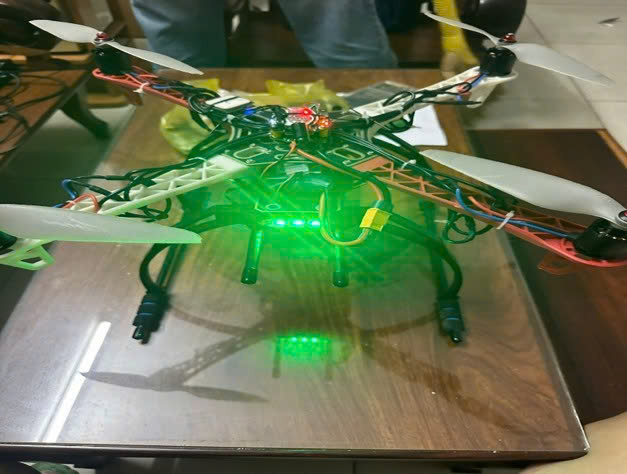
A modern drone typically comprises the following core components:
- Airframe and Propulsion System: The airframe serves as the primary structural load-bearing component, securing internal electronics and ensuring flight stability. Brushless motors, integrated with Electronic Speed Controllers (ESCs), generate the required aerodynamic lift via propellers.
- Flight Controller: Acting as the central processing unit or the "brain" of the drone, the flight controller continuously aggregates data from various sensors and dynamically adjusts the rotational speed of each motor to maintain equilibrium during flight.
- Sensor System: Drones are equipped with an array of sensors, including:
+ Accelerometers
+ Gyroscopes
+ Magnetometers
+ Barometric pressure sensors
+ Global Positioning System (GPS)
These sensors enable the drone to determine its coordinates, velocity, orientation, and altitude with high precision.
- Wireless Communication System: Control commands and acquired data are transmitted via advanced communication protocols such as:
+ RF 2.4 GHz
+ Wi-Fi
+ Bluetooth
+ 4G/5G networks
Consequently, operators can pilot drones from long distances and monitor telemetry data in real time.
3. Key Applications of Drones
Smart Agriculture: Drones are deployed to monitor crop health, detect pests and diseases, assess soil quality, and execute precision pesticide spraying. This significantly minimizes labor costs and optimizes agricultural productivity.
Monitoring and Surveying: Regulatory and management bodies leverage drones to conduct infrastructural surveying, power line inspections, traffic monitoring, and environmental impact assessments without requiring direct physical access.
Search and Rescue (SAR): In disaster-stricken zones or hazardous terrains, drones facilitate the rapid location of missing persons, provide real-time aerial imagery of the site, and expedite damage assessment.
Cinematography and Media: By capturing high-altitude visual data, drones provide unique aerial perspectives that serve cinematography, tourism, brand promotion, and digital media.
Logistics and Delivery: Major technology enterprises are actively researching and deploying drone-based delivery solutions aimed at accelerating transit times and optimizing operational costs.
4. The Role of Electronics and Telecommunications Engineering in Drone Development
Drones serve as a clear manifestation of technological convergence within the field of Electronics and Telecommunications Engineering.
Students majoring in this discipline have the opportunity to engage in research and practical experimentation covering topics such as:
- Control circuit design.
- Microcontroller programming and embedded systems.
- Sensors and data acquisition.
- Digital signal processing.
- Internet of Things (IoT).
- Wireless communication systems.
- Artificial Intelligence (AI) for autonomous navigation.
Through drone-centric research projects, students not only reinforce their theoretical knowledge but also develop scientific research methodologies, collaborative teamwork skills, and the capacity to solve real-world engineering problems.
5. Future Development Tendencies
The convergence of drones, artificial intelligence, and next-generation communication networks is unlocking substantial development opportunities. Future iterations of drones are projected to operate fully autonomously, engage in swarm intelligence (coordinated group behavior), and execute complex missions with minimal human intervention.
This remains a high-potential research domain for both faculty and students within the Electronics and Telecommunications Engineering Department, actively contributing to the cultivation of high-quality human resources to meet the nation's technological demands.
REFERENCES
- Austin, R. (2010). Unmanned Aircraft Systems: UAVS Design, Development and Deployment. Wiley.
- Valavanis, K.P., & Vachtsevanos, G.J. (2015). Handbook of Unmanned Aerial Vehicles. Springer.
- ICAO (International Civil Aviation Organization). Manual on Remotely Piloted Aircraft Systems (RPAS).
- Bộ Thông tin và Truyền thông Việt Nam. Các báo cáo về chuyển đổi số và ứng dụng công nghệ UAV trong giai đoạn 2020–2025