Introduction
Wireless telecommunications form the foundation of most modern communication systems, ranging from mobile networks and the Internet of Things (IoT) to satellite systems, wireless sensor networks, intelligent transportation systems, and smart factories.
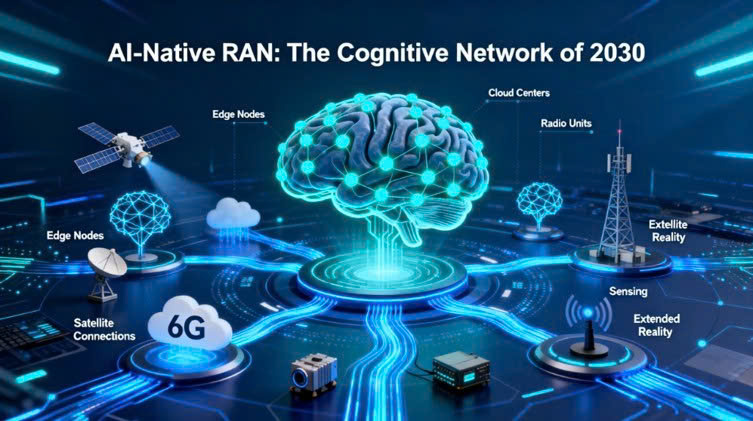
Following the rapid development of 5G, the research community and international standardization organizations are increasingly focusing on 6G, or IMT-2030, with the goal of developing intelligent networks based on an AI-Native Network architecture. Such networks are expected to possess the ability to learn, optimize, and adapt autonomously to changing operating environments.
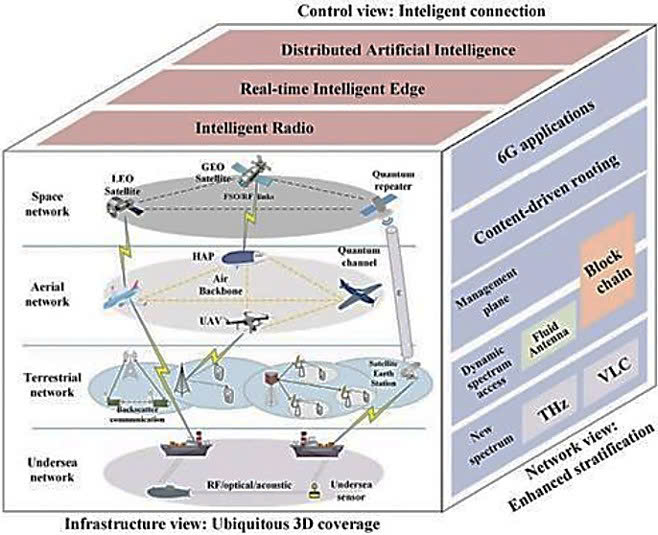
According to the ITU-R IMT-2030 framework, 6G will not only enhance key 5G capabilities such as data rate, latency, and energy efficiency, but will also introduce new capabilities, including AI and Communication (AIAC), Integrated Sensing and Communication (ISAC), and Ubiquitous Connectivity.
Key Technologies of 6G
1. AI-Native Wireless Networks
Unlike 5G, in which AI is primarily used to optimize individual network functions, 6G is envisioned according to an AI-Native philosophy. Artificial intelligence will be integrated throughout the network, from the physical (PHY) layer and radio resource management to spectrum management, beamforming control, network operation, and maintenance.
This approach will enable networks to automatically adapt to changing traffic conditions, reduce energy consumption, and improve overall quality of service.
2. Terahertz (THz) Communications
6G is expected to explore frequency bands ranging from approximately 100 GHz to 10 THz, potentially enabling data transmission rates of up to several terabits per second (Tbps).
However, operating in these frequency bands presents significant technical challenges, requiring advanced antenna technologies, high-performance RF circuits, and sophisticated algorithms to compensate for signal attenuation caused by atmospheric absorption.
3. Reconfigurable Intelligent Surfaces (RIS)
Reconfigurable Intelligent Surfaces (RIS) are intelligent metasurfaces capable of controlling the reflection direction and phase of electromagnetic waves.
This technology can improve network coverage, reduce transmission power, and enhance spectrum efficiency without requiring the deployment of a large number of additional base stations.
4. Integrated Sensing and Communication (ISAC)
Integrated Sensing and Communication (ISAC) enables a single wireless infrastructure to perform communication and sensing functions simultaneously. It can support positioning, object detection, and environmental monitoring.
This technology is particularly important for autonomous vehicles, robotics, smart cities, and Industry 4.0 applications.
5. Semantic Communications
Unlike conventional communication systems, which primarily focus on transmitting bits of data, Semantic Communication aims to transmit the meaning or semantic information contained in data.
By focusing on information relevance rather than simply transmitting raw data, semantic communications have the potential to significantly reduce communication traffic and improve efficiency for AI-driven applications.
6. Digital Twin Networks
A Digital Twin Network creates a digital replica of a telecommunications network, enabling real-time simulation, monitoring, and optimization of network operations.
This technology is expected to provide an important foundation for intelligent network management, predictive maintenance, and future autonomous network operations.
Key Applications
The aforementioned technologies are expected to enable a wide range of emerging applications, including:
- Autonomous vehicles and intelligent transportation systems;
- Smart factories and industrial robotics;
- Smart cities;
- Internet of Everything (IoE);
- Low-latency telemedicine;
- Extended Reality (XR), the Metaverse, and holographic communications;
- Integration of satellite and terrestrial networks through Non-Terrestrial Networks (NTN);
- Intelligent defense and security systems.
Vision Toward 2030
According to ITU-R and 3GPP, the standardization of 6G is progressing according to the IMT-2030 framework and roadmap.
The first commercial 6G systems are expected to emerge around 2030, with the broader goal of developing an Intelligent Network of Everything, in which people, devices, robots, sensors, and infrastructure are intelligently interconnected through AI, cloud computing, and next-generation wireless technologies.
The development of 6G is therefore expected to represent more than simply an increase in network speed. It signals a fundamental transformation toward intelligent, adaptive, sensing-capable, and highly interconnected communication infrastructure.
MSc. Hồ Quốc Bảo
Van Hien University
Source: IEEE
Scientific References
- ITU-R Recommendation M.2160 – Framework and Overall Objectives of IMT-2030 (6G).
- IEEE Technology Navigator – 6G Mobile Communication.
- Pennanen, H. et al. (2024). 6G: The Intelligent Network of Everything. arXiv.
- Singh, R. et al. (2024). Towards 6G Evolution: Three Enhancements, Three Innovations, and Three Major Challenges. arXiv.
- 6G: A Survey on Technologies, Scenarios, Challenges, and Related Issues. ScienceDirect.
- Fundamentals of 6G Communications and Networking. Elsevier, 2026.
- AI-Enabled Wireless Communication in 6G: A Review of Current Trends and Developments. IEEE Xplore.