ABSTRACT
This study aimed to evaluate the effects of supplementing diets with earthworm (Perionyx excavatus) fluid on growth, reproduction, and economic efficiency of Dong Tao chickens raised in Phu Cat, Binh Dinh. The experiment involved 125 one-day-old chicks, randomly assigned to five groups (1 control – CTL and 4 experimental – EXP) receiving different levels of earthworm fluid supplementation (3 ml or 5 ml per 100 g of feed) across two phases (5–9 and 10–22 weeks of age). After 22 weeks, all experimental groups supplemented with earthworm fluid showed significant improvements in measured parameters. The EXP4 group (supplemented with 5 ml in both phases) achieved the best outcomes: highest final body weight (3,147.7 g/bird), highest survival rate (88%), earliest sexual maturity (154 days), highest egg production in the first 8 weeks (15.5 eggs/hen), and lowest feed conversion ratio (FCR) (4.45). Profit from the experimental groups was 2.8 to 3.5 times higher than that of the control group. The study concludes that supplementing diets with earthworm fluid, particularly the 5 ml/100 g feed regimen across both phases (EXP4), provides comprehensive benefits and contributes to the sustainable development of the Dong Tao chicken breed locally.
Keywords: Earthworm fluid; Dong Tao chicken; Growth; Reproduction; Economic efficiency; Phu Cat
1. INTRODUCTION
Dong Tao chicken (Gallus gallus domesticus) is a rare indigenous breed of Vietnam, valued for its high economic potential due to its flavorful meat and distinctive physical characteristics. However, the breed has limitations, including slow growth, low reproductive performance, and the risk of genetic degradation. In the context of sustainable poultry farming, exploring natural, nutrient-rich feed alternatives to partially replace industrial feed is essential to reduce costs, improve animal health, and enhance product quality.
Earthworm (Perionyx excavatus) is recognized as a high-quality protein source, rich in essential amino acids, vitamins, and minerals. Numerous studies have demonstrated the benefits of earthworm supplementation in poultry diets, enhancing growth and egg production. In Binh Dinh, commercial poultry farming is developing rapidly, yet studies on the application of earthworm fluid for rare indigenous breeds such as Dong Tao chicken under local ecological conditions remain limited.
Based on this context, the present study was conducted to comprehensively evaluate the effects of earthworm fluid supplementation at different levels on growth, reproduction, disease resistance, and economic efficiency of Dong Tao chickens raised in Phu Cat District, Binh Dinh Province.
Table 1. Survival rates of Dong Tao chickens at different age stages
The results showed that survival rates in all groups supplemented with earthworm fluid were higher than in the control group. The EXP4 group achieved the highest survival rate (88%), while the control group (CTL) reached only 80%. This difference was mainly observed after 16 weeks of age.
Regarding health status, the experimental groups exhibited significantly lower incidences of digestive and respiratory diseases compared to the control. This improvement may be attributed to antimicrobial peptides and immune-enhancing compounds present in the earthworm fluid, which helped strengthen the birds’ resistance.
3.2. Growth performance
Table 2. Body weight (g) of Dong Tao chickens at different ages
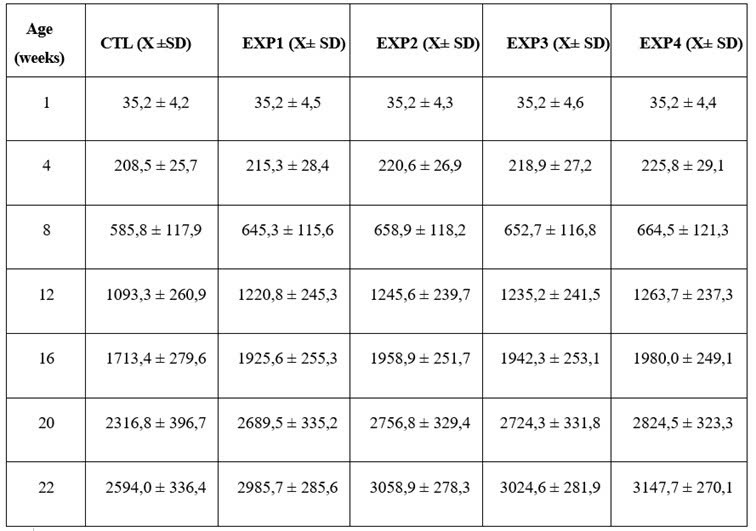
Body weight gradually increased with age in all groups. From week 6 onward, all experimental groups consistently exhibited higher body weights than the control group. By 22 weeks of age, the average body weight of the EXP4 group reached 3,147.7 g, which was significantly higher (p < 0.05) than that of the control group (2,594.0 g).
The average absolute daily gain (ADG) over the 4–22 week period in the experimental groups ranged from 19.85 to 21.61 g/day, exceeding that of the control group (17.66 g/day). The relative growth rate (RGR) was highest during the early phase and gradually declined over time.
Regarding body measurements, at 22 weeks, all parameters (body length, shank length, chest girth, shank length, and shank diameter) in the experimental groups were higher than those in the control group. Notably, shank diameter—a characteristic feature of Dong Tao chickens—in the EXP4 group (28.42 mm) was significantly larger (p < 0.05) than that of the control group (26.68 mm).
3.3. Reproductive Performance
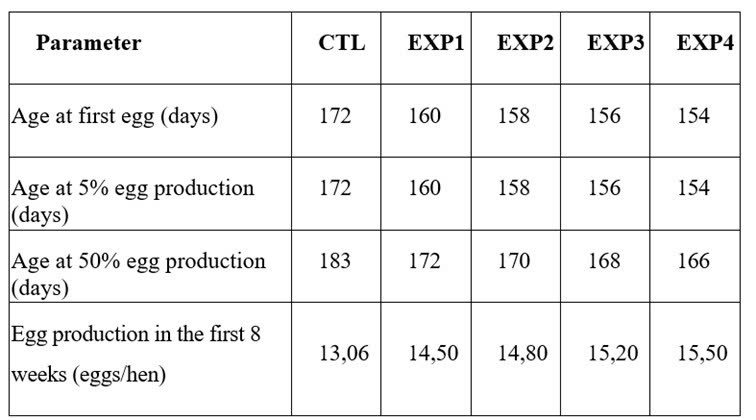
The reproductive performance results are presented in detail in Table 3. Overall, all groups supplemented with earthworm fluid showed advantages in terms of age at sexual maturity and egg production compared to the control group. Among them, the EXP4 group (supplemented with 5 ml/100 g CMF in both phases) exhibited the most outstanding results.
Table 3. Age at sexual maturity and egg production of Dong Tao chickens
3.3. Reproductive Performance
Specifically, hens in the EXP4 group reached sexual maturity earliest, with the age at first egg and 5% egg production both at 154 days, 18 days earlier than the control group (CTL, 172 days). The age at 50% egg production for EXP4 was 166 days, 17 days earlier than CTL (183 days). These results indicate that supplementation with a high and consistent dose of earthworm fluid (EXP4) significantly shortened the sexual maturity period of the flock.
Regarding egg production, EXP4 achieved the highest performance, with 15.50 eggs per hen during the first 8 weeks of laying, which was 2.44 eggs/hen higher than the control and exceeded the other experimental groups. This further confirms the positive effect of earthworm fluid supplementation, particularly in the EXP4 regimen, on the reproductive performance of Dong Tao chickens by providing a balanced and rich nutrient source that optimizes ovarian development and egg quality.
3.4. Feed Efficiency and Economic Performance
The overall feed conversion ratio (FCR) during 4–22 weeks in the experimental groups (4.45–4.60) was better than that of the control group (5.47). The EXP4 group exhibited the lowest FCR (4.45), indicating that earthworm fluid supplementation improved feed utilization efficiency.
Regarding economic efficiency, although additional costs were incurred for purchasing earthworm fluid, the higher final body weight and better survival rates in the experimental groups led to substantially higher total revenue compared to the control. Profit from the experimental groups was 2.8–3.5 times higher than the control, with EXP4 achieving the highest profit.
4. CONCLUSION
The results confirm that supplementing diets with earthworm fluid has a positive and comprehensive effect on the productivity and economic efficiency of Dong Tao chicken farming in Phu Cat, Binh Dinh. Specifically, earthworm fluid not only improved survival rates and overall flock health but also promoted vigorous growth, as reflected in body weight and body measurements (particularly shank diameter) exceeding those of the control group.
Reproductive performance was also significantly enhanced through reduced age at sexual maturity and increased egg production. These advantages led to optimized feed utilization and 2.8–3.5 times higher economic returns in the experimental groups. Among the tested regimens, supplementing 5 ml of earthworm fluid per 100 g of complete feed during both phases (5–9 weeks and 10–22 weeks; EXP4) yielded the best results and is recommended for practical application to sustainably develop the valuable Dong Tao chicken breed locally.
REFERENCES
- Wikipedia (2022). Poultry farming. Wikipedia, The Free Encyclopedia. Accessed 01/01/2024, from https://vi.wikipedia.org/wiki/Chăn_nuôi_gia_cầm
- Thái Trần Bái (1979). Invertebrates. Education Publishing House.
- Binh Dinh Department of Agriculture and Rural Development (2016). “Report on Livestock Survey as of 1/10/2016,” No. 682/BC-CTK.
- Binh Dinh Provincial Government Portal. Accessed 01/01/2024, from https://www.binhdinh.gov.vn
- (2008). Biological basis of poultry breeding and nutrition. Science and Technology Publishing House.
- Nguyễn Văn Duy (2013). Reproductive performance of Ho chickens in smallholder farms, Thuan Thanh District, Bac Ninh Province. Master thesis, Hanoi University of Agriculture.
- Nguyễn Huy Đạt, Vũ Thị Hưng, Hồ Xuân Tùng, Vũ Chí Thiện (2006). Production performance of crossbred Egyptian × Ri vàng rơm chickens under semi-intensive conditions. Scientific Report 2005, Livestock Research Institute.
- (2023). Physiology of Earthworms. PHT Earthworm Farm. Accessed 01/01/2024, from http://traigiunquepht.com/home/
- Bùi Hữu Đoàn, Nguyễn Thị Mai, et al. (2011). Parameters used in poultry production. Agriculture Publishing House, Hanoi.
- Bùi Hữu Đoàn, Nguyễn Xuân Lưu (2006). Some biological characteristics and production performance of Ho chickens. Journal of Science and Technology in Agriculture.
- Bùi Hữu Đoàn, et al. (2008). Some biological characteristics and production performance of Ho chickens. Agriculture Publishing House, Hanoi.
- Vũ Thị Đức (2010). Biological characteristics, growth, and reproduction of H’mong chickens under semi-intensive and free-range systems in Thuan Chau, Son La. Master thesis, Hanoi National University of Education.
- Văn Lệ Hằng (2007). Livestock breeds textbook. Education Publishing House.
- Vũ Thị Thu Huyền (2014). Biological characteristics, growth, and reproduction of Dong Tao chickens raised at Thuy Phuong Research Center. Bachelor thesis, Hanoi National University of Education.
- (2023). The significant benefits of earthworm fluid. Quang Ngai Farmers’ Association. Accessed 01/01/2024, from http://hoinongdanquangngai.org.vn
- Bùi Đức Lũng, Vũ Thị Hưng, Lê Đình Lương (2004). Report on maintaining the Dong Tao chicken gene pool. “Conference on Livestock Gene Conservation (1990–2004).” Livestock Research Institute.
- Lê Hồng Mận (2012). Backyard free-range chicken farming techniques. Science and Technology Publishing House.
- Trần Đình Miên, Nguyễn Văn Thiện (1995). Livestock selection and breeding. Agriculture Publishing House, Hanoi.
- Nguyễn Bá Mùi, Nguyễn Chí Thành, Lê Anh Đức, Nguyễn Bá Hiếu (2012). Morphological traits and meat production of chin-feathered local chickens in Luc Ngan, Bac Giang. Journal of Science and Development.
- Đỗ Bích Ngọc (2010). Biological characteristics and production performance of A-L crossbred chickens in Dong Anh, Hanoi. Bachelor thesis, Hanoi National University of Education.
- Lương Ngọc (2023). Dong Tao chicken – a famous specialty of Hung Yen. Science & Development. Accessed 01/01/2024, from http://khoahocphattrien.com
- General Statistics Office of Vietnam. Accessed 01/01/2024, from https://www.gso.gov.vn
- Hồ Xuân Tùng, Nguyễn Huy Đạt, Vũ Chí Thiện, Nguyễn Huy Tuấn (2010). Morphology and production performance of VP2 × improved Ri (R1) crossbred chickens. Journal of Science and Technology. Livestock Research and Training Center, Livestock Research Institute.
- Hồ Xuân Tùng, Nguyễn Huy Đạt, Vũ Chí Thiện, Nguyễn Thị Thu Hiền (2010). Morphology, growth, and reproductive performance of three Ho, Mia, and Mong chicken breeds after one generation of selection. Scientific Report 2009, Livestock Genetics Section, Livestock Research Institute.
- Nguyễn Đình Thái (2009). Production performance of Sao (Hungarian) and Egyptian chickens raised in Binh Dinh. Scientific Report.
- Đỗ Thị Thanh (2011). Biological characteristics and production performance of imported ZoLo chickens in the first generation. Bachelor thesis, Hanoi National University of Education.
- Nguyễn Hoàng Thịnh, Phạm Kim Đăng, Vũ Thị Thúy Hằng, Hoàng Anh Tuấn, Bùi Hữu Đoàn (2016). Morphological traits and production performance of polydactyl chickens raised in Xuan Son National Forest, Tan Son District, Phu Tho Province. Journal of Science and Development.
- Nguyễn Đăng Vang, Trần Công Xuân, Phùng Đức Tiên, Lê Thị Nga, Nguyễn Mạnh Hùng (1999). Production performance of Dong Tao chickens raised in Thuy Phuong. Vietnam Poultry Association Journal.
- Trần Công Xuân, Nguyễn Huy Đạt (2006). Research on developing high-quality free-range chicken lines in Vietnam. Ministry-level Scientific Report, Ministry of Agriculture and Rural Development, Hanoi.