Durian — known as the “king of fruits” — is renowned not only for its distinctive flavor but also for the massive quantity of discarded husks generated each harvest season. A recent study has introduced a promising new direction: converting durian husks into a stabilizing agent for low-fat chocolate ice cream.
In Vietnam, the durian yield in 2024 is estimated to generate at least 150,000 tons of husks. Instead of becoming a burden on landfills, this agricultural waste is being revitalized by researchers from Van Hien University and Ho Chi Minh City University of Technology, who have transformed it into a valuable ingredient: low-methoxyl pectin (LMP).
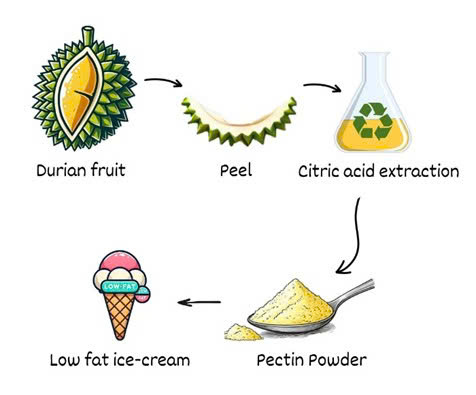
Presented below are the key highlights of the study on applying this type of pectin to develop a clean-label, low-fat ice cream that maintains its sensory appeal
1. Durian Husks: A Source of High-Quality Pectin
Pectin is a common food additive, widely used for gelling and stabilizing structures. However, instead of relying on commercial citrus-derived pectin, the research team extracted pectin from the Ri6 durian variety using a hot citric acid treatment, a safe organic acid method.
Extraction results:
- Yield: Approximately 18.63%, significantly higher than several previous studies.
- Purity: Galacturonic acid content reached nearly 77%, meeting food-grade pectin standards.
- Characteristics: This is a low-methoxyl pectin (LMP), capable of forming gels with calcium without requiring high sugar content, making it highly suitable for low-fat dairy products.
2. Challenges of Low-Fat Ice Cream and Pectin-Based Solutions
Low-fat ice cream often faces major issues such as reduced creaminess, ice crystal formation, and rapid melting. Fat plays a key role in maintaining structure and sensory appeal. When fat is reduced, an effective substitute is needed.
The study incorporated durian husk pectin into low-fat chocolate ice cream (approximately 7.9% fat) at concentrations of 0.17%, 0.34%, 0.50%, and 0.67%.
Remarkable results on ice cream properties:
- Melting resistance: Ice cream containing pectin melted significantly more slowly. The sample with 0.34% pectin extended the dripping onset from 11 minutes (control) to 41 minutes.
- Hardness: Pectin enhanced structural integrity, making the ice cream firmer and preventing rapid collapse at room temperature.
- Overrun (air incorporation): Although pectin slightly reduced overrun compared to the pectin-free sample, at an optimal level (0.34%), the ice cream achieved 83% overrun—a desirable value for smoothness.
3. The “Golden Ratio” for Perfect Flavor
The key question: Does ice cream made from durian husks taste good?
Sensory evaluation showed that consumers did not perceive a significant difference in taste between low-fat ice cream supplemented with pectin and traditional full-fat ice cream.
- Optimal concentration: 0.34%–0.50% durian husk pectin is the “sweet spot.”
- At this level, the ice cream’s texture, melting behavior, and flavor were comparable to ice cream with 30% higher fat content.
- Excessive pectin (>0.50%) resulted in overly dense and less airy ice cream.
4. Safety and Market Potential
The product is not only delicious but also food-safe. After two weeks of frozen storage, pectin-supplemented ice cream samples showed no harmful bacteria (E. coli, Salmonella) and were free of heavy metals such as lead (Pb).
Practical significance:
- Health: Produces low-fat, lower-calorie desserts without compromising taste.
- Environment: Reduces agricultural waste and promotes a circular economy.
- Economy: Adds value to Vietnamese durian production, transforming by-products into high-value food ingredients.
Conclusion:
This study demonstrates that durian husk-derived pectin is a promising clean-label stabilizer. It addresses structural challenges in low-fat products and exemplifies the application of scientific innovation for sustainable agriculture. In the near future, we can expect refreshing, healthy ice cream made from familiar agricultural by-products.
References
Dang-Bao, T., Huynh, U. D. H., Mang, T. T. X., & Tran, U. P. N. (2025). Durian rind-derived low methoxyl pectin as a clean-label stabilizer for reduced-fat chocolate ice cream. Applied Food Research, 5, 101441. https://doi.org/10.1016/j.afres.2025.101441