Introduction
The Mekong Delta (MD), known as Vietnam's "rice bowl" and fruit basket, faces significant challenges in managing agricultural byproducts. Each year, massive quantities of fruit seeds and shells from durian, mango, rambutan, and custard apple are discarded, often burned or dumped, causing environmental pollution and greenhouse gas emissions. In this context, pyrolysis technology for producing biochar from these byproducts emerges as a sustainable solution offering dual economic and environmental benefits.
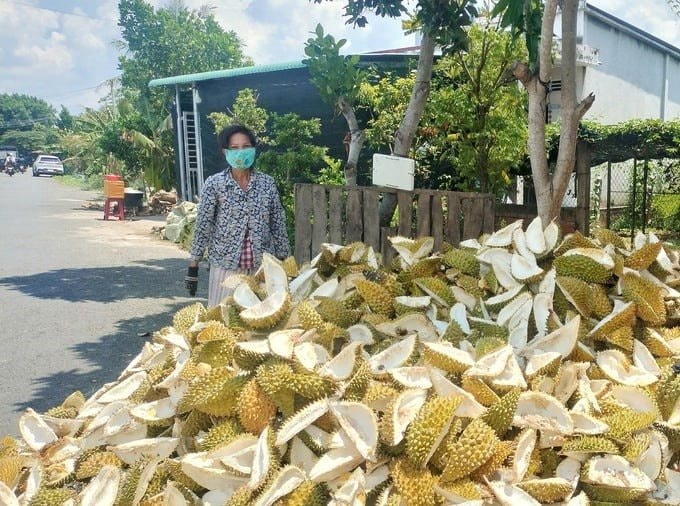
Figure 1 Illustration: Large quantities of durian seeds collected after processing, showing the massive waste volume requiring management.
Massive Potential from Underutilized Resources
The MD contributes over 50% of Vietnam's fruit production, generating enormous volumes of processing waste. From 2010 to present, fruit production has steadily increased, with durian yields reaching 550,000-750,000 tons annually. Given that seeds constitute 20-30% of fruit weight, this translates to 110,000-225,000 tons of durian seeds alone. Similarly, mango production (650,000-850,000 tons) yields 65,000-127,500 tons of mango seeds. Combined with other major fruits, the total potential seed feedstock for biochar production in the MD ranges from 222,500 to 472,500 tons annually.

Figure 2 Illustration: Finished biochar from durian seeds, showing black, porous granules ready for soil application.
Multifaceted Applications of Biochar in Agricultural Practice
When subjected to pyrolysis under oxygen-limited conditions, these hard seeds transform into biochar - a black, porous material with an extensive surface area. This unique structure enables remarkable capabilities, particularly in agricultural soil improvement.
Despite its fertility, MD soils show degradation signs after decades of intensive cultivation: acidification, erosion, and declining organic matter. Biochar's high cation exchange capacity makes it a "nutrient bank" that retains and slowly releases plant nutrients. It significantly improves water and fertilizer retention, reducing losses. Moreover, its slight alkalinity helps neutralize acidity in acidic soils, stabilizing pH naturally. Crucially, its honeycomb structure provides ideal habitat for beneficial soil microorganisms, promoting healthy soil ecosystems.
Field experiments in Hau Giang province revealed that conventionally farmed plots (control) had only 2.1% soil organic matter. However, with applications of 2 tons and 4 tons of biochar per hectare, these levels increased to 2.8% and 3.4% respectively. Improved soil fertility directly translated to yield gains. While control plots yielded 6.5 tons/ha/crop, biochar-amended plots achieved 7.2 to 7.8 tons/ha/crop, demonstrating tangible economic benefits for farmers.
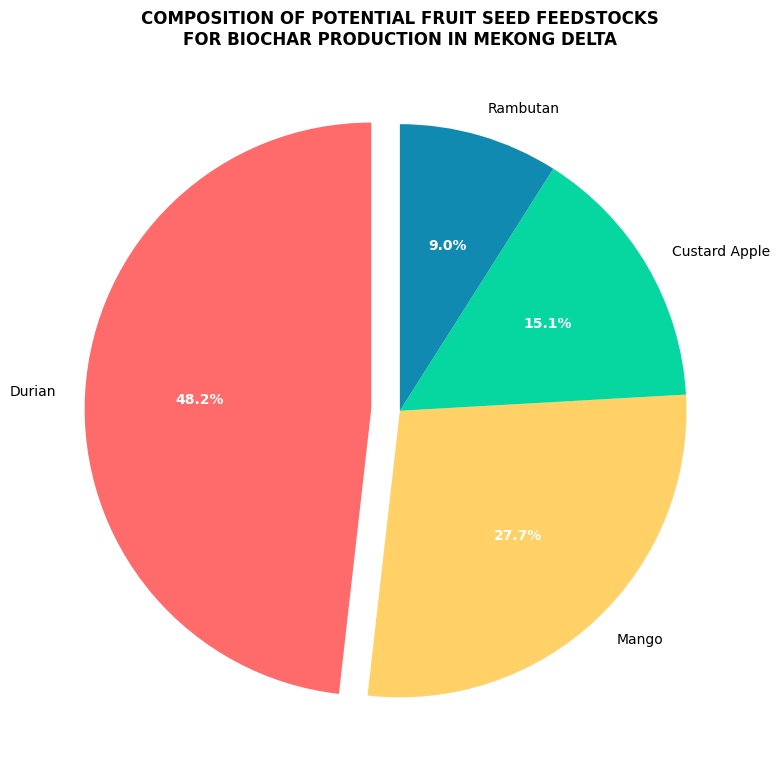
Chart 1: Composition of Potential Fruit Seed Feedstocks
Beyond soil amendment, biochar serves as a powerful tool against climate change. Unlike direct burning of waste that releases significant CO2 and toxic gases, pyrolysis converts biomass carbon into a stable form that can persist in soils for centuries to millennia. This represents effective "carbon sequestration" technology. Assuming 30% pyrolysis efficiency and 70% carbon content in biochar, the total carbon that could be sequestered annually from fruit seeds in the MD exceeds 200,000 tons. This contribution has significance beyond national borders, supporting global emission reduction efforts.
Additionally, biochar has versatile applications. It serves as excellent livestock bedding, absorbing moisture and ammonia, improving barn environments, and later being reused as soil amendment - completing a circular cycle. In environmental treatment, its large surface area makes it ideal for wastewater filtration or odor control. It can even be used as a valuable solid fuel.
Challenges and Development Roadmap
Despite enormous potential, scaling biochar from research to widespread field application faces obstacles. Initial investment costs for efficient, emission-controlled pyrolysis reactors remain substantial. Farmer awareness of biochar's long-term benefits is limited, with preference for quick-acting chemical fertilizers. Supportive policies, quality standards, and stable market mechanisms for biochar are still underdeveloped.
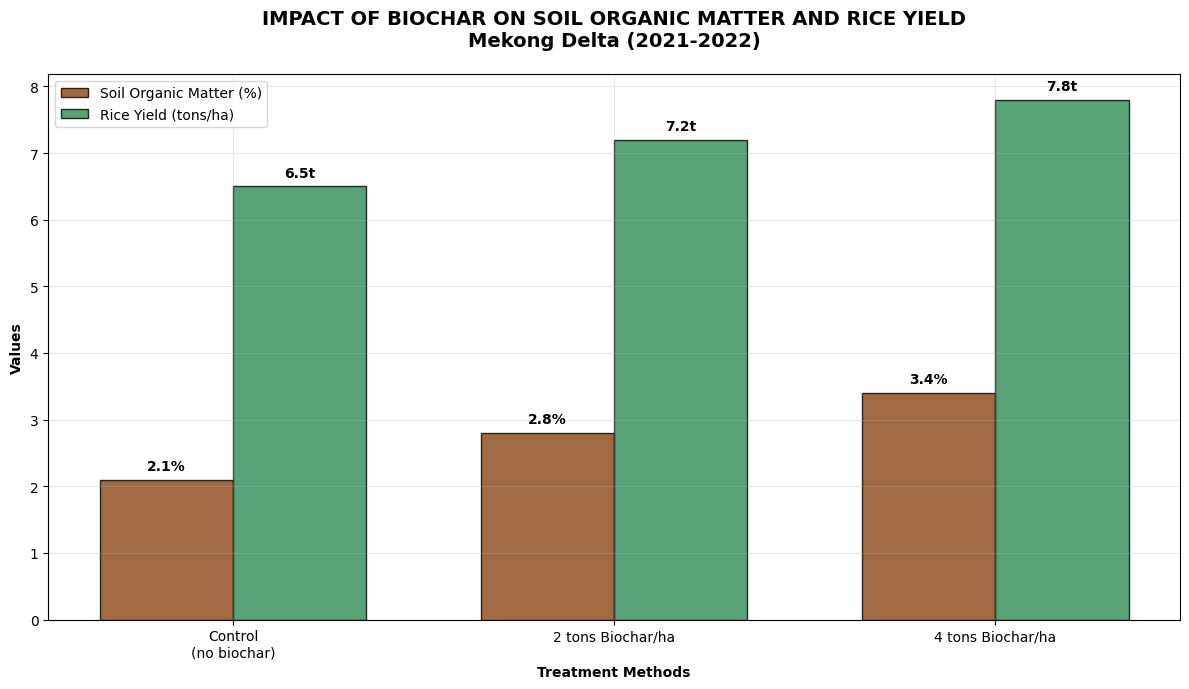
Chart 2: Impact of Biochar on Soil Organic Matter and Rice Yield
To overcome these challenges, a coordinated roadmap is essential. First, research should optimize pyrolysis processes for specific feedstocks to reduce production costs. Second, technology transfer programs should develop small-scale, affordable reactors suitable for cooperatives or households. Third, awareness campaigns and training are crucial to demonstrate biochar's "dual benefits." Government support should formally recognize biochar as an organic soil amendment and establish tax incentives and credit support to encourage private investment.
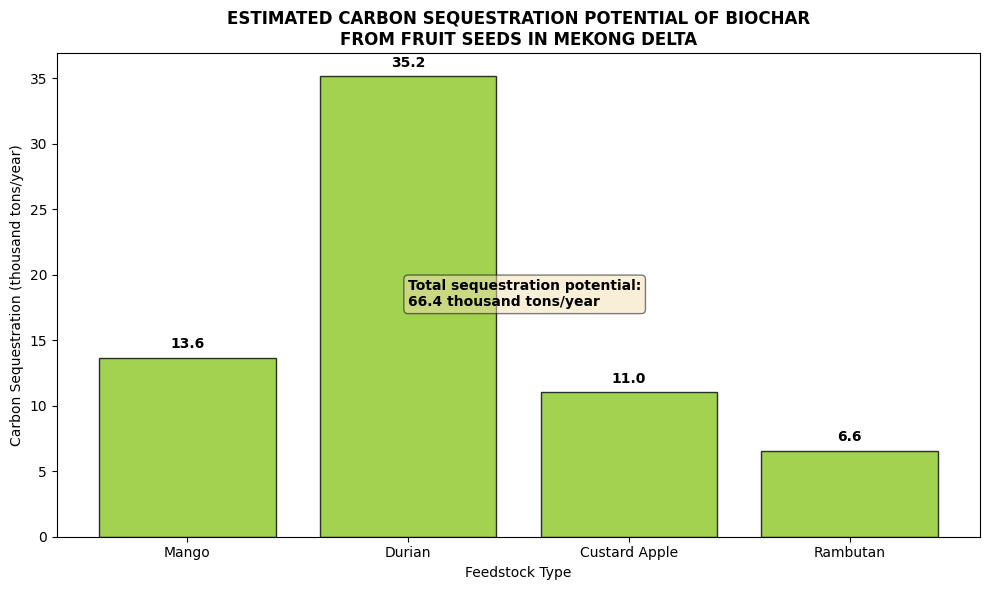
Chart 3: Carbon Sequestration Potential
Conclusion
Durian, mango, and custard apple seeds - once considered worthless - are being scientifically transformed with a new mission. They are no longer environmental burdens but "golden biomass" - raw materials for a circular, sustainable agricultural system. Developing biochar production from agricultural waste in the MD is not merely a technical solution but a strategic paradigm shift: from "waste disposal" to "resource regeneration," from "extraction" to "restoration." Realizing this potential requires tight collaboration between four stakeholders: scientists, policymakers, businesses, and farmers. When achieved, the Mekong Delta will be renowned not only for its sweet fruit orchards but also as a model of green, smart agriculture adapting to climate change.
References:
- General Statistics Office (GSO). (2010-2023). Statistics of Agriculture, Forestry and Fishery.
- Tran Van Dung, Le Thanh Phong, & Nguyen Thi Thanh Thuy. (2020). Research on biochar production from durian seeds for planting media and soil improvement. Journal of Soil Science, 54, 45-52.
- Le Van Be Ba, & Vo Thi Guong. (2019). Effects of biochar from rice husk and cashew nutshell on acidic soil properties and rice yield in the MD. Journal of Science and Technology Development, 22(4), 123-134.
- International Biochar Initiative (IBI). (2015). Standardized Product Definition and Product Testing Guidelines for Biochar That Is Used in Soil.
- Ministry of Agriculture and Rural Development (MARD). (2018). Report on environmental status of agriculture and rural areas in the MD region.