1. Potential Applications of Nanotechnology in Controlling Pathogenic Bacteria
Nanotechnology is developing rapidly and exerting a significant impact across many fields, including the control of pathogenic bacteria in humans and animals. Nanomaterials, characterized by sizes ranging from 1 to 100 nm, exhibit strong potential for application in both in vivo and in vitro studies (Savithramma et al., 2011; Singh et al., 2008). One of the most critical challenges today is antimicrobial resistance (AMR), which has made bacterial infections increasingly difficult to treat (Bush et al., 2011). Nanotechnology offers new research directions due to its ability to deliver and release therapeutic compounds, while certain types of nanoparticles (metallic, organic, carbon-based, etc.) can disrupt resistance mechanisms, inhibit biofilm formation, or interfere with bacterial metabolic processes (Elbourne et al., 2017).
In addition, strategies combining nanomaterials with natural antimicrobial agents have been developed to inhibit efflux pumps, block bacterial metabolic exchange with the environment, prevent biofilm formation and quorum sensing, and destroy plasmids carrying antibiotic resistance genes. Studies on toxicity and the optimization of the antibacterial efficacy of nanomaterials continue to be conducted, particularly for compounds derived from natural sources.
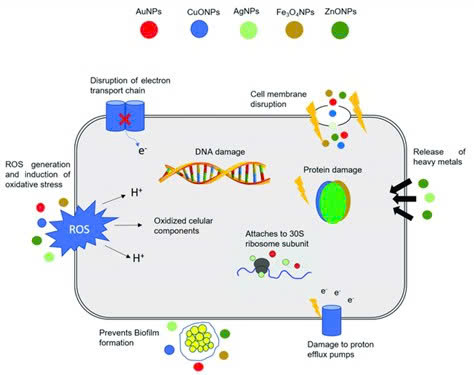
Figure 1. Different mechanisms of action of nanoparticles within bacterial cells. The interaction of a single nanomaterial can trigger multiple cellular effects that act against multidrug-resistant (MDR) bacteria. DNA, deoxyribonucleic acid; ROS, reactive oxygen species; AuNPs, gold nanoparticles; CuONPs, copper oxide nanoparticles; AgNPs, silver nanoparticles; Fe₃O₄ NPs, iron oxide nanoparticles; ZnONPs, zinc oxide nanoparticles.
2. Applications of Nanotechnology in Aquaculture
2.1. Applications in Feed Production
Feed production is a key area for nanotechnology applications in aquaculture. Nano-chitosan enables efficient delivery of micronutrients, while carbon nanomaterials (SWCNTs, fullerenes, nTiO₂) support feed intake control. In addition, nFe, nSe, nTiO₂, and nZnO have been shown to promote growth performance in aquatic organisms (Rather et al., 2011).
2.2. Applications in Improving Reproductive Performance of Aquatic Animals
Reproduction and seed quality remain major challenges in aquaculture. Nano-chitosan has been investigated as a carrier for the controlled delivery and release of reproductive hormones, prolonging hormone circulation time in the bloodstream and thereby enhancing egg quantity, egg quality, and fertilization rates (Pulavendran et al., 2011). Furthermore, nano-chitosan stimulates luteinizing hormone secretion, increases Sox9 expression and steroid levels, and supports gonadal development (Bhat et al., 2016).
2.3. Applications in Disease Prevention and Treatment in Aquatic Animals
Aquatic organisms are exposed to numerous pathogens (bacteria, fungi, viruses), which are commonly controlled using chemicals or antibiotics. Nanomaterials are considered promising antimicrobial agents, particularly against drug-resistant bacteria, while nano-based rapid diagnostic tools enable efficient pathogen detection. Nano-chitosan has also been tested as a DNA vaccine carrier against viral diseases. However, many applications are still at the experimental stage and require further evaluation of efficacy and safety (Shaalan et al., 2016).
2.4. Applications in Aquaculture Environmental Management
Water pollution poses a major threat to aquaculture, resulting from waste, residual drugs, and uneaten feed. Nanoproducts such as aerogels, polymers, hydrophobic organoclays, and magnetic nanoparticles have been investigated for water treatment and contaminant removal. nAu, nAg, CNTs, nFe, lanthanum, and nTiO₂ are effective in removing pesticides, ammonia, heavy metals, and phosphates from water. Quantum dots are being studied for the rapid detection of toxic heavy metal ions (Rather et al., 2011; Bhattacharyya et al., 2015).
2.5. Applications in Wound Healing
Skin injuries compromise protective functions and can lead to severe infections or even mortality if not properly controlled, particularly those caused by Staphylococcus aureus and Pseudomonas spp. Nano-ZnO exhibits strong antibacterial activity against these pathogens while promoting tissue regeneration, reducing inflammation, and accelerating wound healing. ZnO-NPs have demonstrated superior performance compared to conventional ZnO, especially against Gram-positive bacteria, and show potential for treating dermatitis, ulcers, and blistering conditions (Kumar et al., 2012).
2.6. Applications in the Preservation of Aquaculture Feed
The increasing incidence of food contamination necessitates strict quality control of raw materials and finished products. Preservatives play a crucial role in ensuring safety and extending the shelf life and transportability of feed. Due to its high stability and safety, nano-ZnO has been proposed for use in aquaculture food preservation. Silver, copper, and titanium nanoparticles have also been applied in packaging materials, with ZnO-NPs showing effective antibacterial activity against E. coli and S. aureus in polyvinyl chloride films (Li et al., 2009).
2.7. Applications as Feed Additives in Aquaculture
Aquaculture feed additives provide balanced nutritional supplementation, serve as alternatives to antibiotics, enhance animal health, and reduce side effects and costs. Supplementation with zinc or ZnO at appropriate levels helps control intestinal bacterial populations, reduce diarrhea, and improve production efficiency (Case & Carlson, 2000).
3. Conclusion
Nanotechnology offers numerous promising applications in controlling pathogenic bacteria, improving aquaculture productivity, managing environmental quality, and protecting animal health. Nevertheless, challenges related to biosafety, toxicity, stability, and the long-term impacts of nanomaterials on the environment and consumer health require further in-depth investigation.
PhD. Pham Thi Hai Ha¹,*
Faculty of Engineering and Technology, Van Hien University
* Corresponding author: Pham Thi Hai Ha, hapth@vhu.edu.vn
REFERENCES
- Savithramma, N., Lingarao, M., Suvarnalatha, P., et al. (2011). Evaluation of antibacterial efficacy of biologically synthesized silver nanoparticles using stem bark of Boswellia ovalifoliolata. Journal of Biological Sciences, 11, 39–45.
- Singh, M., Singh, S., Prasada, S., et al. (2008). Nanotechnology in medicine and the antibacterial effect of silver nanoparticles. Digest Journal of Nanomaterials and Biostructures, 3, 115–122.
- Bush, K., et al. (2011). Tackling antibiotic resistance. Nature Reviews Microbiology, 9(12), 894–896.
- Rather, M., Sharma, R., Aklakur, M., Ahmad, S., Kumar, N., Khan, M., & Ramya. (2011). Nanotechnology: A novel tool for the developmental stages of medaka fish. Water Research, 47, 3899–3909.
- Elbourne, A., Crawford, R. J., & Ivanova, E. P. (2017). Nanostructured antimicrobial surfaces: From nature to synthetic analogues. Journal of Colloid and Interface Science, 508, 603–616.
- Pulavendran, S., Chellan, R., & Asit, B. (2011). Hepatocyte growth factor–incorporated chitosan nanoparticles. Journal of Nanobiotechnology, 9(1), 1.
- Shaalan, M., Saleh, M., & El-Matbouli, M. (2016). Applications of nanoparticles in fish medicine: A review. Nanomedicine: Nanotechnology, Biology and Medicine, 12, 701–710.
- Bhattacharyya, A., Reddy, S. J., & Hasan, M. M. (2015). Nanotechnology – a future technology in aquaculture for food security. International Journal of Bioassays, 4, 4115–4126.
- Kumar, P. T., Lakshmanan, V. K., Ramya, C., et al. (2012). Chitosan hydrogel/nano-ZnO composite bandages for wound dressing: In vitro and in vivo evaluation. ACS Applied Materials & Interfaces, 4, 2618–2629.
- Case, C. L., & Carlson, M. S. (2002). Effect of feeding organic and inorganic sources of additional zinc on growth performance and zinc balance in nursery pigs. Journal of Animal Science, 80, 1917–1924.