Abstract
The overuse of antibiotics in Koi carp aquaculture has been causing numerous consequences for the environment and drug resistance. To address this challenge, a new study by Thi H.H.P. et al. (2026) has demonstrated the breakthrough potential of Bouea macrophylla leaf extract. Not only does this herbal extract strongly inhibit the pathogenic bacterium Enterococcus faecalis, but it also exhibits the ability to protect liver function and enhance the survival of Koi carp overcoming acute ammonium toxic shock. This is considered a potentially significant step forward toward a safe and sustainable aquaculture management model.
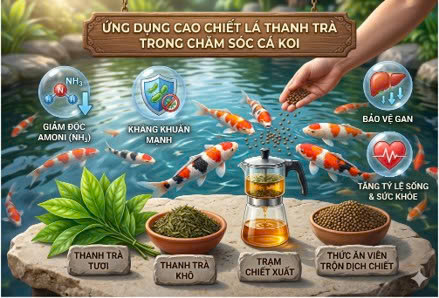
1. Introduction
In the field of aquaculture in general and ornamental fish farming in particular, the abuse of antibiotics to control diseases is leaving complex consequences. Antimicrobial resistance not only directly threatens the development of livestock but also exerts negative impacts on the ecological environment. For Koi carp, the opportunistic bacterium Enterococcus faecalis and fluctuations in environmental factors—especially elevated ammonium concentrations due to waste and excess feed—are always major challenges, leading to extremely severe stock depletion rates.
Against this backdrop, searching for alternative solutions from nature is becoming an inevitable trend. A recent study on Bouea macrophylla leaf extract has opened up a highly promising direction. Possessing an abundant content of bioactive compounds with potent antibacterial and antioxidant properties, such as polyphenols and flavonoids, this herbal remedy is evaluated as an effective solution to reduce dependence on antibiotics in Koi carp farming.
2. Outstanding Disease Prevention, Treatment, and Antibacterial Potential
In vivo trials have provided clear evidence of the protective capacity of Bouea macrophylla leaf extract, demonstrating efficacy that occasionally surpasses conventional practical treatment protocols.
When conducting therapeutic trials on a group of Koi carp infected with Enterococcus faecalis, the fish flock supplemented with 1% extract in their diet fully recovered with an absolute survival rate (100%). Conversely, when using only a low dosage (0.5% extract) or intervening with a common antibiotic like Doxycycline, the survival rate of the fish flock leveled off at 60%. This confirms that the 1% dosage is the optimal threshold to activate the strongest protective mechanism.
In addition to its therapeutic capability, the Bouea macrophylla leaf extract also clearly demonstrates its role in natural disease prevention. Maintaining a diet containing 1.5% extract significantly inhibited the proliferation of Vibrio bacteria in the fish kidneys. This prophylactic potential was evidenced by a 60% survival rate after 10 days of pathogen exposure—twice as high as that of the unprotected control group (30%) and approaching the antibiotic-prophylaxis group (65%).
3. Enhancement of Ammonium Stress Resistance and Liver Function Protection
Ammonium is one of the "silent killers" in aquaculture ponds, often insidiously destroying the respiratory system and causing acute toxicity in fish. The tolerance of Koi carp was challenged through an exposure model with an ammonium nitrogen concentration of 0.5 mg/L for 24 consecutive hours.
The obtained results were truly impressive: The fish group protected by 1% Bouea macrophylla leaf extract survived without any recorded mortality. To clearly observe the contrast, this toxic environment wiped out 90% of the fish population in the control group and caused up to 43.33% mortality in the Doxycycline-treated group.
Furthermore, the herbal extract acts as a shield to protect the physiological system. Biochemical analysis revealed that while both the control and antibiotic groups experienced major fluctuations in liver enzyme levels (SGPT) —a warning sign of cellular damage and stress induced by toxicity—the group utilizing Bouea macrophylla leaf extract maintained these parameters within normal physiological thresholds.
4. Application and Scientific Orientations
Although the experimental data offer highly positive signals, experts still advise that the practical application of Bouea macrophylla leaf extract should be viewed objectively:
- Solution Positioning: Currently, Bouea macrophylla leaf extract should be regarded as a potential biological adjuvant to enhance resistance and alleviate disease pressure, rather than a drug capable of completely replacing targeted antibiotics.
- Environmental Variables: The aforementioned results were recorded under controlled laboratory conditions. When applied to commercial farming ponds, the efficacy may fluctuate due to the complexities of water quality, temperature, and stocking density.
- Synchronization: To optimize the functionality of the herb, farmers are required to combine its use in parallel with standard water filtration systems, strict waste management protocols, and a balanced nutritional regimen.
In the future, larger-scale trials across diverse real-world farming environments will serve as a solid foundation to standardize and commercialize this highly promising biological solution.
TÀI LIỆU THAM KHẢO: Hai Ha Pham Thi, Hong Lien Dang Le, Do-Hyung Kim & Thanh Luan Nguyen. Therapeutic effect of Bouea macrophylla Griffith in protecting Koi fish from Enterococcus faecalis infection and acute ammonia toxicity. Vet Res Commun 50, 47 (2026). https://doi.org/10.1007/s11259-025-10978-4